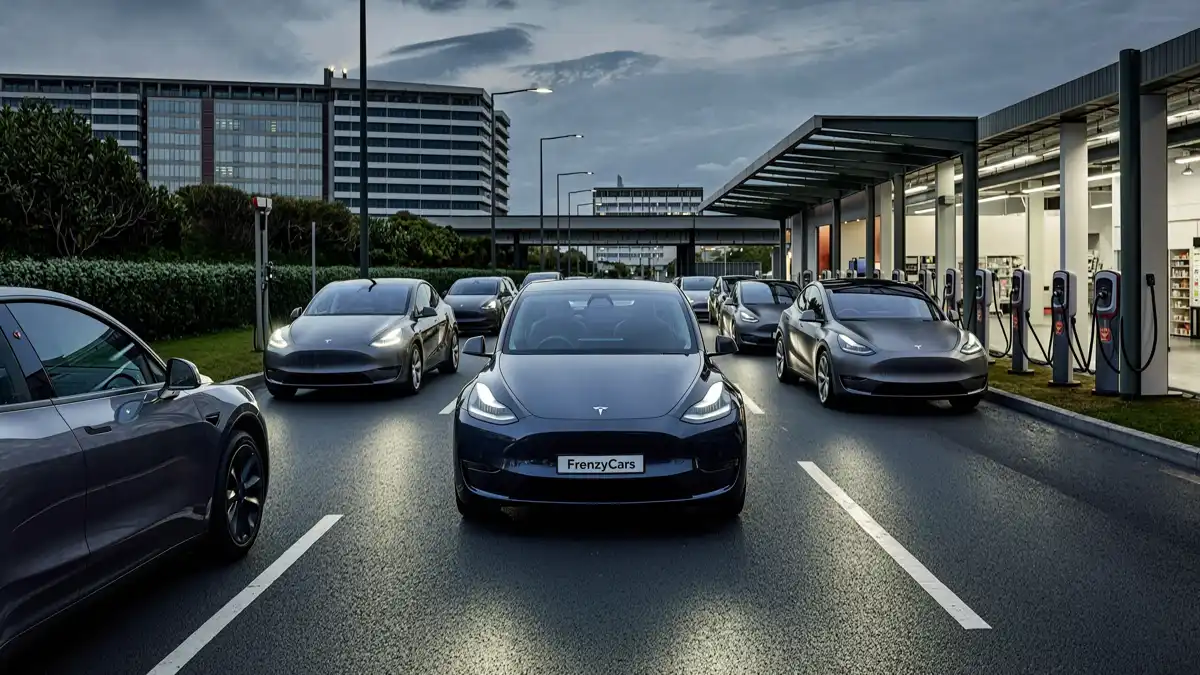
Tesla is living a tale of two realities. In Australia, the all-new six-seat Model Y L has become one of the country’s hottest-selling electric vehicles, with delivery waits blowing out as demand outstrips supply. Yet back on the financial front, the company just posted a negative free cash flow of $1.1 billion and saw its stock plunge 14% after second-quarter earnings. For enthusiasts and buyers, the question is whether the product momentum can outrun the balance-sheet headwinds.
Model Y L Mania Down Under: Why Australia Can’t Get Enough
According to Drive.com.au, Tesla’s newest and largest Model Y—the six-seat L variant—has quickly become one of the hottest-selling EVs in Australia. Customers placing orders today face extended delivery waits, a clear sign that supply is struggling to keep pace with demand. This is the kind of consumer frenzy automakers dream of, and it’s happening in a market that has embraced Tesla’s expanded lineup with open arms.
The Model Y L is the biggest version of Tesla’s already-popular crossover, offering three rows of seats in a six-passenger configuration. For Australian families looking to go electric without sacrificing space, it fills a gap that no other Tesla has covered. The blowout in delivery times suggests that initial production allocation is being snapped up faster than Tesla can ship them Down Under, mirroring the early days of the Model 3 and Model Y launches in other regions.
This development matters beyond Australia. It signals that Tesla’s product strategy—offering more variants of its volume seller—is working exactly as intended. The Model Y is already the world’s best-selling vehicle by revenue in some quarters; adding a six-seat variant expands the addressable market without requiring an entirely new platform. If Australia is any indication, the Model Y L could become a major volume driver globally, provided Tesla can ramp production to meet demand.
Financial Health Check: The $1.1 Billion Question
On the other side of the ledger, Tesla’s financials are raising eyebrows. According to Archynewsy, the company reported negative free cash flow of $1.1 billion during a critical quarter marked by expensive manufacturing transitions and aggressive price cuts. Free cash flow is a key metric for automakers—it shows how much cash the business generates after capital expenditures. A negative number of this magnitude suggests that Tesla is spending heavily on new production lines (think Cybertruck, next-gen platform) while simultaneously discounting vehicles to maintain sales volumes.
The 14% post-earnings stock drop, reported by The Motley Fool, reflects investor unease. The same source notes that Tesla is still considered overvalued by some analysts, even after the decline. The company does have physical artificial intelligence products in the pipeline, including its Optimus robot and Full Self-Driving hardware, but those have yet to contribute meaningful revenue. For now, the core automotive business is carrying the weight—and it’s feeling the strain.
Interestingly, institutional investor activity during the first quarter tells a mixed story. SEC filings cited by various reports show that several firms increased their stakes: Weiss Asset Management boosted its holdings by 41.8%, OMERS Administration Corp raised by 23%, Waverly Advisors increased by 15.8%, and Gamco Investors grew by 4.9%. Entropy Technologies even initiated a new position, buying 13,444 shares. On the other hand, Renaissance Technologies slashed its position by 84.5%, selling over 1.15 million shares. The conflicting moves suggest that even professional money managers are divided on Tesla’s near-term outlook.
Global Expansion Continues: Tesla Lands in Uruguay
Amid the financial turbulence, Tesla is not slowing its geographic expansion. According to Barrio, Tesla officially launched in Uruguay with an event in Montevideo, marking another step in the company’s push across Latin America. This is a relatively small market today, but it adds to Tesla’s footprint in a region where EV adoption is still in its infancy. For enthusiasts, it means more service centers, more superchargers, and a growing global network that benefits travelers and owners.
Uruguay joins a list of Latin American countries where Tesla has recently established a presence. The move aligns with Tesla’s long-term goal of making electric vehicles accessible worldwide, even if near-term sales from such markets remain modest. The real significance is strategic: as traditional automakers retreat from certain regions, Tesla is planting flags.
Taken together, these developments paint a picture of a company that is simultaneously on fire and under pressure. Product demand for the Model Y L in Australia is undeniably strong, and expansion into new markets like Uruguay shows ambition. But the $1.1 billion negative free cash flow and the stock’s 14% haircut are reminders that growth comes at a cost. For buyers and enthusiasts, the takeaway is that Tesla’s vehicles remain highly desirable—but the company itself is navigating one of its most challenging financial patches in recent memory.
Expect delivery waits for the Model Y L in Australia to persist as Tesla works to boost supply. Meanwhile, the company’s next quarterly report will be closely watched for signs that cash flow is stabilizing. The Model Y L’s success is a bright spot, but it will take more than hot demand in one market to silence the skeptics.