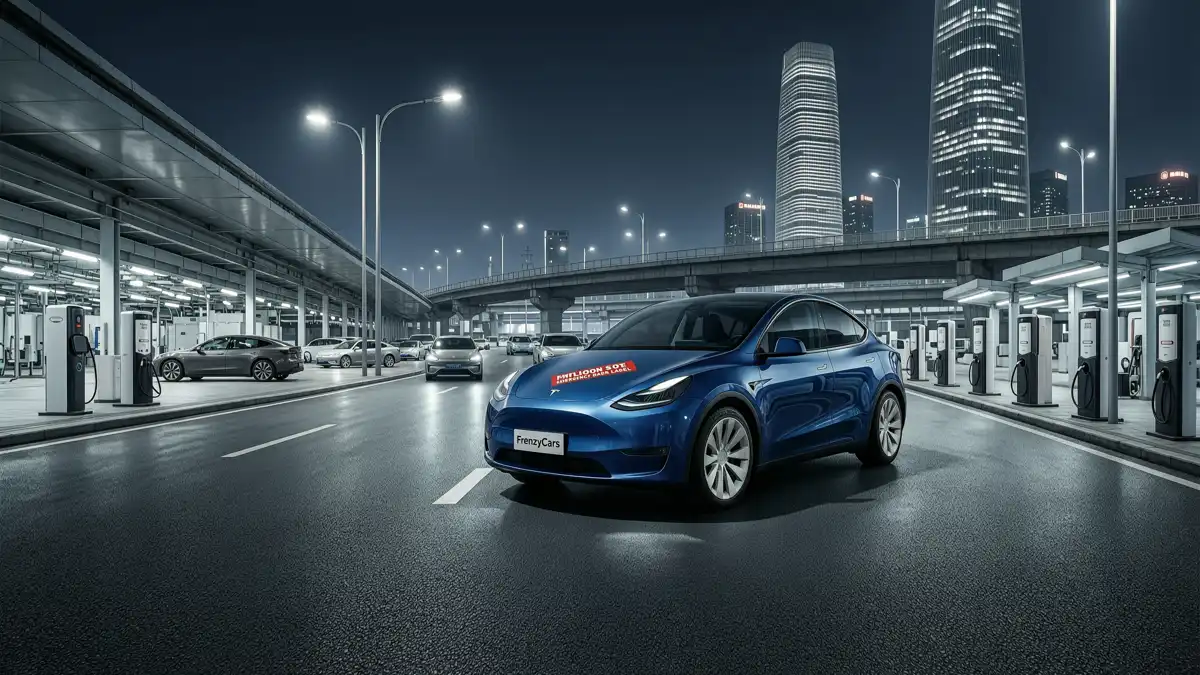
Chinese regulators are forcing Tesla to retrofit nearly three million electric vehicles with clearer emergency-exit instructions, placing the automaker at the center of the largest recall campaign in China’s automotive history. According to Chinese authorities and reporting from Ars Technica, Tesla must add warning labels to 2.98 million Model 3 and Model Y vehicles in China to make it clearer how passengers can open the rear doors in an emergency. The action covers both locally produced and imported cars.
Tesla’s recall is the biggest single piece of a much larger campaign. Chinese authorities have ordered around 4.3 million vehicles to be recalled, with Tesla joined by eight other automakers. The campaign highlights growing scrutiny of vehicle safety in China as automakers increasingly rely on electronic controls, software, and unconventional designs — and it comes amid concerns that passengers could struggle to open their doors during an emergency. The scale of the action shows how quickly regulators are moving on safety issues tied to the way modern EVs are designed.
For Tesla owners, this is more than a compliance formality. The flush, electronically actuated door handles that help give the Model 3 and Model Y their clean, futuristic look are exactly the kind of feature Chinese safety officials are now scrutinizing. In normal use, those handles are low-drag and easy to operate. In an emergency, they can be confusing — especially for a passenger in the back seat who may not know where the release is or how it works. The label retrofit is a direct acknowledgment that a design which feels intuitive in everyday driving may not be obvious to someone in a panic.
Why Flush Handles Are Suddenly a Safety Issue
Flush or hidden door handles have become widespread on electric vehicles because they improve aerodynamics and lend a futuristic silhouette. Tesla was one of the first automakers to popularize the approach, and numerous EV brands followed. The trade-off is that these handles rely on electronics and software, and they ask occupants to learn a new way of opening a door. In an emergency, that extra step can be exactly the wrong thing to put between a person and an exit.
Chinese regulators have sharpened their focus on that trade-off following EV accidents in China and elsewhere in which hidden electronic doors failed and trapped people inside, according to Chinese authorities. Tesla’s immediate fix is not a new mechanical handle but a clearer explanation: warning labels that tell owners and passengers how to open the rear doors in an emergency. It is a low-tech solution to a high-tech problem, and it underscores how much modern cars now depend on electronic controls and unconventional interfaces. For the EV industry broadly, it is also a reminder that design choices made for aesthetics and efficiency carry safety consequences.
A Record Campaign Ahead of a 2027 Ban
The 4.3-million-vehicle recall involving Tesla and eight other automakers is not just about fixing a current problem; it is also about changing how cars are designed in the future. New regulations in China will ban flush and hidden door-handle designs starting in 2027, according to Chinese authorities. That gives automakers a clear timeline to redesign a signature feature that is now central to many EVs. For Tesla, that means the current label retrofit is likely just an interim measure — a way to make today’s cars safer while the industry prepares for a hardware shift.
This matters well beyond China. The country is the world’s largest car market, and its safety standards increasingly shape global design priorities. A ban on flush handles in China will push automakers to think twice about using the same designs in other markets, even where regulators have not yet weighed in. For car shoppers, the lesson is simple: the interface you use every day has to work when you are not thinking clearly.
Driver Monitoring Is the Other Side of China’s Safety Push
The door-handle recall is not the only compliance issue Tesla is managing in China. In a separate action, Tesla is recalling 2.74 million China-built Model 3 and Model Y cars to add in-cabin driver monitoring. The update is designed to ensure that a driver’s hands can be on the wheel but their eyes remain on the road — a clear move toward active attention monitoring rather than simply detecting contact with the wheel.
Taken together, the two actions show that Chinese regulators are looking at the entire human-machine interface of modern Teslas, not just the bodywork. Tesla has long argued that software and sensors can replace traditional controls; China’s recent actions suggest that safety systems need to be explicit, robust, and easy for occupants to understand in a crisis. For Tesla owners in China, the next step is straightforward: the company will need to complete the label retrofit and driver-monitoring update across millions of vehicles in the coming months, while the rest of the automotive world watches how far China is willing to push EV design.