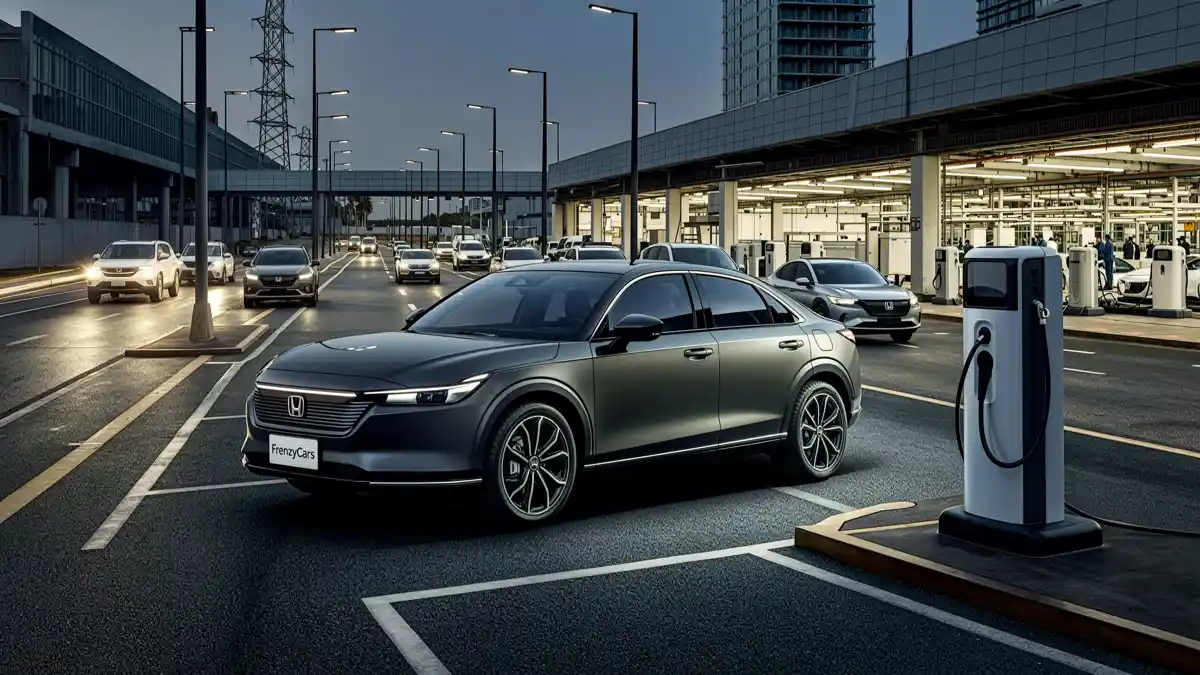
Honda’s electric vehicle experiment in the United States has come to an abrupt end. The automaker has confirmed it will discontinue the Honda Prologue—its only fully electric model currently on sale in the country—after the 2026 model year, effectively exiting the U.S. EV market by 2027. The decision marks a stunning reversal for a brand that had promised a robust electric future just a few years ago.
Prologue Sales Collapse by Nearly Half
The Prologue’s demise was sealed by a dramatic sales decline. According to industry reports, deliveries of the Prologue plummeted 48% in the first half of 2026 compared to the same period in 2025, falling to just 8,400 units. That collapse left Honda with little choice but to end production of the model that was meant to be its electric vanguard. The Prologue was launched in early 2024 as a joint venture with General Motors, using GM’s Ultium platform and battery technology. It initially seemed promising—Honda even touted it as one of the best-selling EVs in certain months of 2025. But demand faded quickly as competition intensified and consumer interest in EVs cooled in the U.S. market.
Honda Now Has Zero EVs in the U.S. Lineup
With the Prologue’s discontinuation, Honda will offer no battery-electric vehicles in the United States for the foreseeable future. The company had previously canceled its next-generation 0 Series EVs in March 2026, which were supposed to arrive after 2026 with Honda’s own dedicated architecture. Those models were scrapped amid shifting market conditions and internal reassessments. The result: Honda’s U.S. showrooms will be entirely devoid of EVs, even as rivals like Hyundai, Kia, Ford, and Tesla continue to push electric models. Honda will instead rely on its hybrid lineup, including the CR-V Hybrid and Accord Hybrid, which have seen steady demand. The brand is also investing in fuel-cell technology, but no production hydrogen vehicle is currently offered to U.S. consumers.
Why This Matters for Enthusiasts and Buyers
For driving enthusiasts and car buyers, Honda’s EV pullback is more than a corporate footnote. It means the end of a model that, while not a true driver’s car in the vein of the NSX (the hybrid supercar that ended production years ago), did offer a competent, spacious electric SUV with Honda’s reliability reputation. The Prologue was often cross-shopped against the Chevrolet Blazer EV, Ford Mustang Mach-E, and Tesla Model Y. Its exit leaves a gap in Honda’s lineup for buyers who want an electric badge from a brand they trust. Moreover, it signals that Honda is prioritizing hybrids and internal combustion engines for the near term—a move that could slow the brand’s transition in a market that is still growing, albeit unevenly. Enthusiasts who were hoping for a sportier Honda EV (perhaps a spiritual successor to the CR-Z or a compact electric sports car) will have to wait indefinitely.
Context: A Broader Industry Pullback
Honda is not alone in scaling back EV ambitions. Several automakers have revised their electric timelines in response to slower-than-expected adoption, higher costs, and infrastructure challenges. However, Honda’s complete exit—rather than a delay or reduction—is a more drastic move. The company had previously committed to making EVs 40% of its U.S. sales by 2030, a target that now appears unreachable. The decision also reflects the difficulty of relying on a partner’s platform: the GM-based Prologue was always a compromise, and Honda’s own 0 Series would have taken longer to bring to market. By canceling both, Honda is effectively resetting its U.S. EV strategy from scratch.
What’s Next for Honda’s U.S. Portfolio?
Honda has confirmed that production of the Prologue will continue through the 2026 model year, meaning current inventory will be sold over the next several months. After that, the only electrified Hondas available will be hybrids. The company is still investing in EV technology for other regions—it recently announced a new F1 power unit with Aston Martin—but has given no specific timeline for an all-new U.S. electric model. For now, buyers looking for a Honda EV will have to look to the used market or consider a competitor. The Prologue’s discontinuation is a stark reminder that even established brands can stumble in the fast-changing landscape of electric mobility.