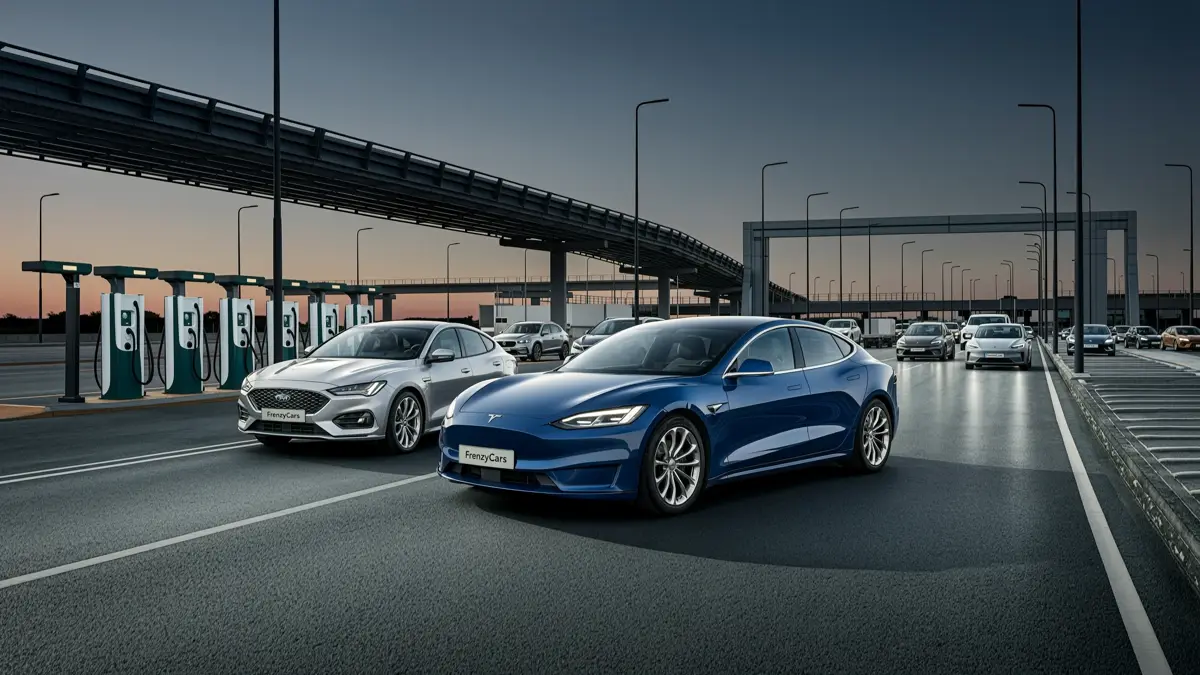
Tesla has never been just an electric car company—and its competition reflects that. As the brand expands from sports cars and trucks into solar energy storage and autonomous driving software, its list of adversaries has grown far beyond traditional automakers. A recent analysis from FourWeekMBA outlines 15 key rivals across three distinct fronts, giving enthusiasts a clear picture of the pressure Tesla faces in 2026.
The EV Rivalry Heats Up: Legacy Names and New Stars
On the electric-vehicle side, Tesla’s competitors span the full spectrum of the automotive world. Traditional giants like Ford, Mercedes-Benz, Toyota, and Audi are pouring billions into electric lineups, while luxury and performance brands Porsche and Lamborghini are developing their own high-voltage offerings. Meanwhile, dedicated EV startups Rivian and Lucid Motors continue to target the same upscale, tech-savvy buyers who once flocked exclusively to Tesla.
What does this mean for Tesla shoppers? More choice than ever. If you’re in the market for an electric truck, you now have the Ford F-150 Lightning, Rivian R1T, and Tesla Cybertruck to compare. For a premium sedan or SUV, the Lucid Air and Mercedes EQS are direct challengers to the Model S and Model X. And Porsche’s Taycan—along with Audi’s e-tron GT—proves that Tesla no longer owns the high-performance EV segment. Toyota’s aggressive push into solid-state batteries and hybrids further complicates the landscape.
But Tesla still holds key advantages: its Supercharger network, over-the-air software updates, and efficiency benchmarks remain hard to beat. According to FourWeekMBA, the breadth of competition shows that the EV market has matured—every major player now sees Tesla as the target.
Beyond Cars: Solar Storage and Self-Driving Software
Tesla’s energy business—built largely around its acquisition of SolarCity—now faces its own set of rivals. The company competes directly with Sunrun, SunPower, and Vivint Solar in the home solar and battery storage market. For Tesla owners who pair a Powerwall with their car, the ecosystem is a strong selling point. But as traditional solar installers offer increasingly competitive pricing and installation flexibility, Tesla’s bundled approach isn’t the only game in town.
Then there’s the autonomous-driving frontier. Tesla’s Full Self-Driving (FSD) software is vying against specialized companies like Zoox, Waymo, and Baidu, all of which are developing their own self-driving systems. Waymo already operates a commercial robotaxi service in several U.S. cities, while Zoox has its own purpose-built vehicle. Baidu leads in China. According to FourWeekMBA, Tesla’s do-it-all strategy—building the car and the software—sets it apart, but it also means competing on two fronts simultaneously.
Real-World Battery Lessons: Cheaper Packs Outlast Costlier Ones
One of the most encouraging findings for Tesla owners comes from a used-EV analysis conducted in Sweden. The study compared Tesla’s lower-priced lithium-iron-phosphate (LFP) battery option with its more expensive nickel-based packs and found that the cheaper LFP chemistry held up better over time. This is a game-changer for buyers considering a standard-range Model 3, which uses LFP cells. Instead of worrying that the budget-friendly pack will degrade faster, the data suggests it may actually offer superior longevity.
For enthusiasts, this means the entry-level Tesla might be the smarter long-term investment—lower initial cost and potentially longer battery life. It also underscores Tesla’s willingness to adopt diverse battery chemistries to suit different markets and price points.
Where to Buy a Tesla Home Charger: Keeping Your Car Powered
Once you’ve decided on a Tesla, the next question is home charging. According to a guide from GB Times, Tesla owners can purchase a home charger directly from Tesla’s online shop, or through third-party retailers like Amazon and local electrical supply stores. The guide recommends buying the official Tesla Wall Connector for best compatibility and fastest charging speeds. For owners who already have a solar setup, pairing the Wall Connector with a Powerwall can create a complete energy ecosystem.
Tesla’s competitors are many, but its integrated approach—from solar to storage to charging to driving—remains a powerful differentiator. As 2026 unfolds, the battle lines are drawn on three fronts: EV sales, energy storage, and autonomous driving. For now, Tesla’s owner experience and brand loyalty keep it at the center of the conversation. Expect more product launches and software updates as the company fights to stay ahead of the 15 rivals closing in.