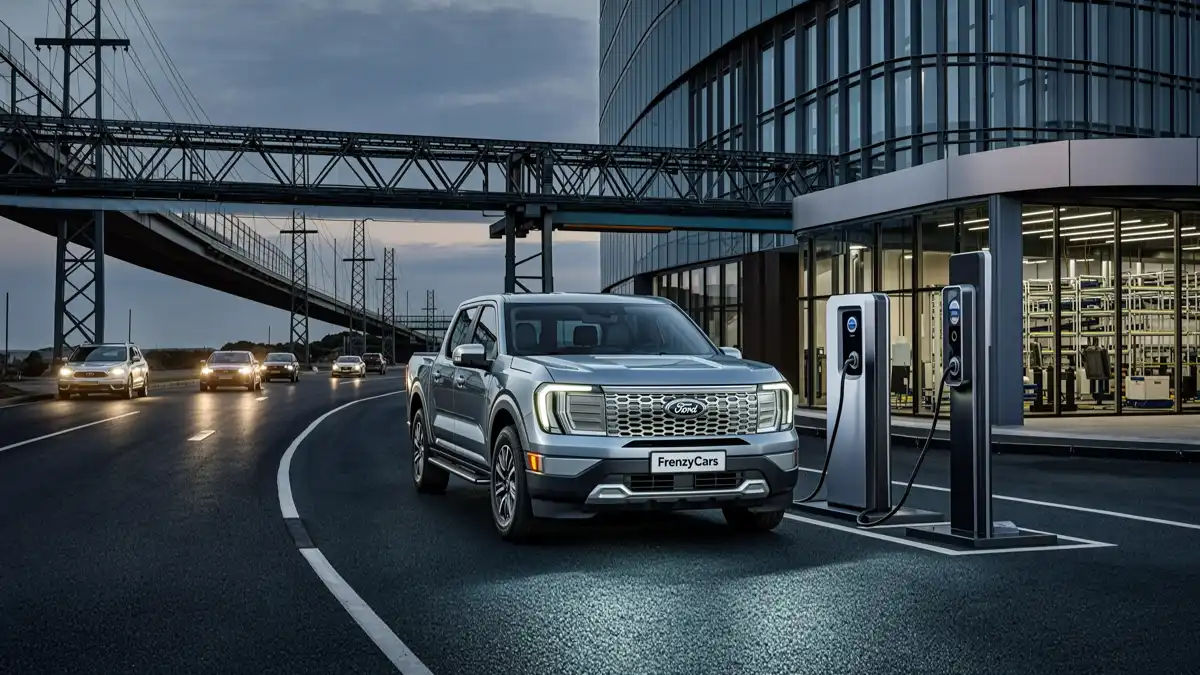
Ford Motor Company has officially confirmed that its next-generation electric vehicles will run Apple Maps as the built-in navigation system, replacing Google Maps in a strategic shift announced Thursday. The move marks the first time an automaker has embedded Apple’s new MapKit for Automotive software development kit into a vehicle platform, and it will debut on a $30,000 midsize electric pickup scheduled for 2027 production.
Why Apple Maps Over Google? EV Route Planning Gets a Native Boost
According to Ford’s announcement, Apple Maps will be integrated directly into the company’s Universal Electric Vehicle (UEV) platform – the architecture underpinning the upcoming pickup and future EVs. That means the mapping software lives on the vehicle’s infotainment system without requiring an iPhone connection; it’s a built-in service, not a smartphone projection.
The decision matters for several reasons. Apple has been refining its EV-routing capabilities, which can factor in charging station locations, battery state-of-charge, and elevation changes along a route – features that have become table-stakes for any competitive EV navigation system. By tying Apple Maps natively into the UEV platform, Ford ensures that route suggestions and charging stops are optimized without relying on a third-party smartphone connection.
But the implications go beyond navigation. Ford said that road data from Apple Maps will also feed its BlueCruise hands-free driving system and the onboard artificial intelligence features. That means improved lane-level mapping, more accurate road geometry for automated lane changes, and potentially richer contextual information for the driver-assistance suite. Ford is betting that Apple’s mapping ecosystem can deliver the precision needed for Level 2+ systems, while avoiding the overhead of maintaining a separate, proprietary map database.
For enthusiasts and early adopters, the shift away from Google Maps – which has been the default on many Ford vehicles through Android Automotive – signals that Ford sees Apple as a stronger long-term partner for driver-assistance data. It also means that Apple Maps will effectively become the digital backbone for the vehicle’s situational awareness, not just a guide to the nearest coffee shop.
The $30,000 Electric Pickup: First Vehicle on the Apple-Powered UEV Platform
Ford confirmed that the first vehicle to ride on the UEV platform with integrated Apple Maps will be a $30,000 midsize electric pickup truck, set for release in 2027. This price point puts it in direct competition with current affordable EV trucks and gasoline-powered midsizers, aiming to attract buyers who have resisted higher-priced electric pickups.
By embedding Apple Maps at the platform level, Ford avoids the need for users to plug in an iPhone for full navigation features. The system will offer turn-by-turn directions, EV-specific routing, and real-time traffic data – all rendered on the vehicle’s native display. For a customer shopping in this segment, the convenience of a seamless, built-in mapping system that doesn’t depend on a phone could be a differentiator against rivals that rely on smartphone projection or less polished native navigation.
Ford’s decision to launch with a $30,000 pickup also signals that the UEV platform is designed for volume. The company has not released detailed specs for the truck, but the price target suggests a no-frills workhorse similar in concept to the combustion-powered Ford Maverick. Apple Maps integration in an affordable EV could accelerate mainstream adoption by removing a common friction point: poor or frustrating navigation in cheaper EVs.
Beyond the Pickup: Apple Maps Will Underpin Future Ford EVs and BlueCruise
Ford made clear that the Apple Maps integration is not a one-off feature for the pickup. The UEV platform is intended to underpin a family of upcoming electric vehicles, all of which will come with built-in Apple Maps from the factory. The company says that data from Apple Maps will also be used to improve BlueCruise and AI systems across the lineup, meaning subsequent models on the same architecture will benefit from the same mapping enhancements.
BlueCruise is Ford’s hands-free driver-assistance system, currently available on select models like the Mustang Mach-E and F-150. By feeding Apple’s high-definition road data into BlueCruise, Ford aims to expand the system’s operational domain and reliability. For example, more accurate lane markings and intersection layouts could enable the system to handle more complex highway interchanges without driver intervention. The AI systems, which manage things like predictive energy usage and cabin comfort, will also draw on Apple Maps data to anticipate route conditions.
For current owners of Ford EVs with Google Maps, this announcement means that the next-generation vehicles will have a fundamentally different navigation and driver-assistance architecture. The company has not indicated whether existing models will receive an over-the-air update to switch to Apple Maps, so the change appears to be exclusive to the UEV platform vehicles starting in 2027.
Ford and Geely Partner for European Production of EVs – Valencia Plant Secured
In a separate but related announcement on July 23, Ford and China’s Geely Auto said they will form a manufacturing joint venture at Ford’s assembly plant in Valencia, Spain. Ford will hold a 66% stake and Geely 34%. The joint venture is expected to begin operations in the first half of 2027, with production of four models starting in 2028. According to reports, those models will include two electric SUVs built by Geely, plus new Ford and jointly developed vehicles produced in Europe for the European market.
The Valencia plant has been at risk due to Ford’s European restructuring, and this deal secures its future while giving Geely a manufacturing foothold in Europe. For Ford, the partnership provides scale to lower production costs for its next-generation EV platform – the same UEV platform that will embed Apple Maps. The timing aligns: the first UEV model (the $30,000 pickup) launches in 2027 in North America, and by 2028 the Valencia joint venture will be producing additional UEV-based vehicles for Europe.
While the Apple Maps announcement grabbed headlines, the Geely deal underscores Ford’s strategy to use partnerships and common platforms to spread development costs. Both moves – the Apple Maps integration and the Geely JV – are aimed at making Ford’s next-generation EVs more competitive in features, pricing, and production efficiency.
What’s Next
Ford has not announced a specific on-sale date for the $30,000 electric pickup beyond the 2027 model-year window. The joint venture in Spain is targeting first-half 2027 for operations start, with vehicles arriving in 2028. Enthusiasts and shoppers tracking Ford’s EV pivot should expect more details on the UEV platform’s range, performance, and BlueCruise capabilities closer to the pickup’s launch. For now, the message is clear: Ford is betting big on Apple Maps to power its next chapter – and it’s willing to walk away from Google to do it.