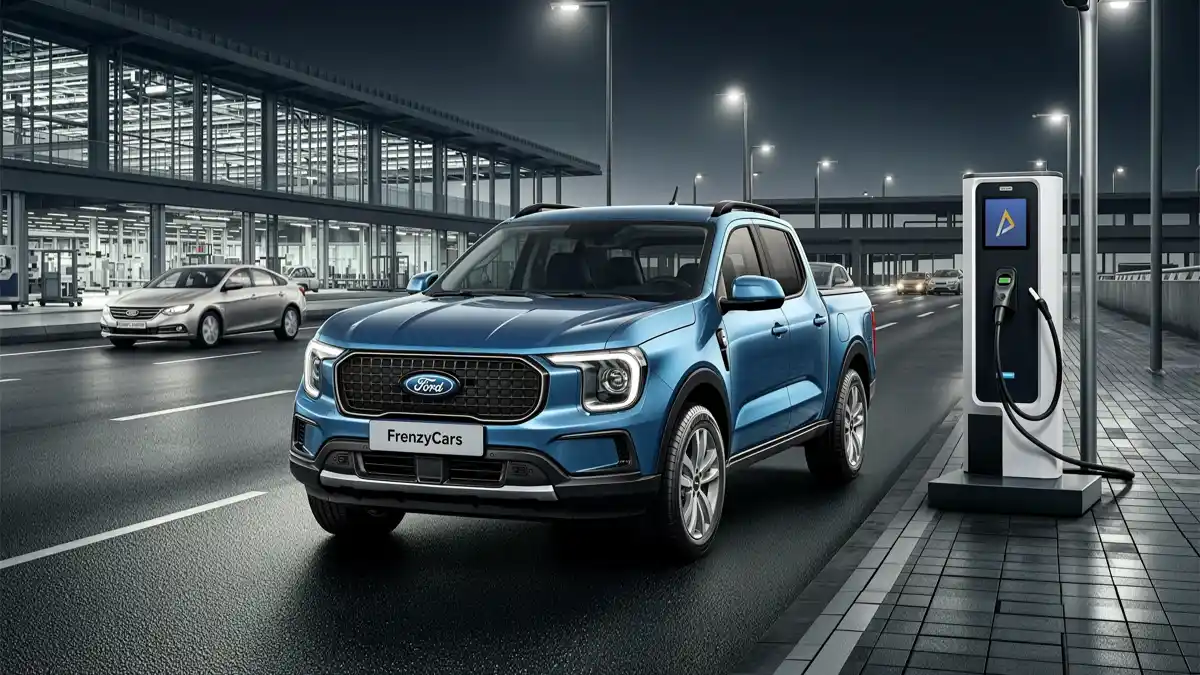
Ford is laying the groundwork for a truly disruptive entry in the electric pickup segment with its upcoming budget ute — widely tipped to revive the Ranchero nameplate — due to go into production in 2027. The vehicle will come standard with Apple Maps as its built-in navigation system, a first for the automaker and a significant step in integrating Apple’s ecosystem directly into Ford’s next-generation vehicles.
According to Ford’s announcement, the Apple Maps integration will be native to the vehicle, meaning it does not require an iPhone to function. The mapping software will also be used to improve Ford’s hands-free driving and AI systems, suggesting the budget ute will offer advanced driver-assistance features that rely on real-time navigation data. This marks the first time a major automaker has adopted Apple Maps as the default nav system rather than a phone-projected solution, giving Ford a unique selling point for tech-savvy buyers in the compact truck segment.
Geely Partnership Paves Way for European Production
The budget electric ute will be built on Ford’s Universal Electric Vehicle Platform, but its manufacturing footprint extends well beyond North America. Ford and China’s Geely automaker have announced a new joint venture focused on Europe, centered on Ford’s existing assembly plant in Valencia, Spain. The agreement will see the factory produce both Ford and Geely multi-energy passenger vehicles — including the affordable electric ute — for the European market.
The Valencia deal is strategically critical: it allows Ford to produce the budget ute locally, side-stepping potential tariffs on Chinese-built EVs while also leveraging Geely’s expertise in cost-effective multi-energy platforms. The partnership is described by the companies as a win-win, though it has raised concerns among European officials about Chinese automakers gaining a production foothold. For enthusiasts, it means the Ranchero revival (or whatever badge it carries) could be sold across the Atlantic without the price premiums that often accompany imported models.
What Apple Maps Brings to the Driving Experience
Ford’s decision to embed Apple Maps goes beyond simple navigation. By making Apple Maps the default mapping service inside the vehicle, Ford can tap into Apple’s rich points-of-interest database, real-time traffic updates, and improved routing algorithms — all without requiring the driver to connect a phone. The integration also supports Ford’s BlueCruise hands-free driving system, which will use the map data to understand road geometry, speed limits, and upcoming curves. The result is a more seamless, safer semi-autonomous experience that doesn’t depend on a cellular connection from the driver’s device.
This is a notable shift from the industry norm, where carmakers typically offer their own branded navigation (often outsourced) or rely on smartphone mirroring. Ford is the first automaker to make Apple Maps the native option, setting a precedent that could push other brands to follow suit. For the budget electric ute, it means a high-quality nav experience out of the box — a feature that enthusiasts and daily drivers alike will appreciate in a vehicle expected to start at roughly $30,000.
Context: Ford’s Broader Moves in 2026
While the electric ute gathers headlines, Ford has been busy on other fronts. The company recently recalled more than 565,000 Bronco and Bronco Raptor SUVs in the United States over an engine bay fire risk caused by a wiring harness short circuit. Additionally, over 140,000 Ranger pickups are being recalled for a separate fire hazard related to sun visor wiring. These actions underscore Ford’s commitment to safety even as it pushes ahead with new platforms.
On the financial side, Wall Street expects Ford to report Q2 2026 earnings on July 28, with consensus EPS of $0.35 on revenue of $45.14 billion. The stock ticked up 1.4% on a recent Friday, trading as high as $14.55 — a sign of cautious optimism among investors as Ford navigates its transition to electrification and multi-energy partnerships.
What This Means for Enthusiasts
The combination of native Apple Maps, a sub-$30,000 price point, and European production via Geely’s joint venture makes Ford’s upcoming electric ute one of the most intriguing vehicles in development. It promises to blend the utility of a compact pickup with the connectivity of a modern smartphone, all while keeping costs low enough to attract first-time EV buyers and traditional truck fans alike. With production slated to begin in 2027, Ford is aiming squarely at the heart of the affordable EV market — and it’s bringing Apple’s mapping ecosystem along for the ride.