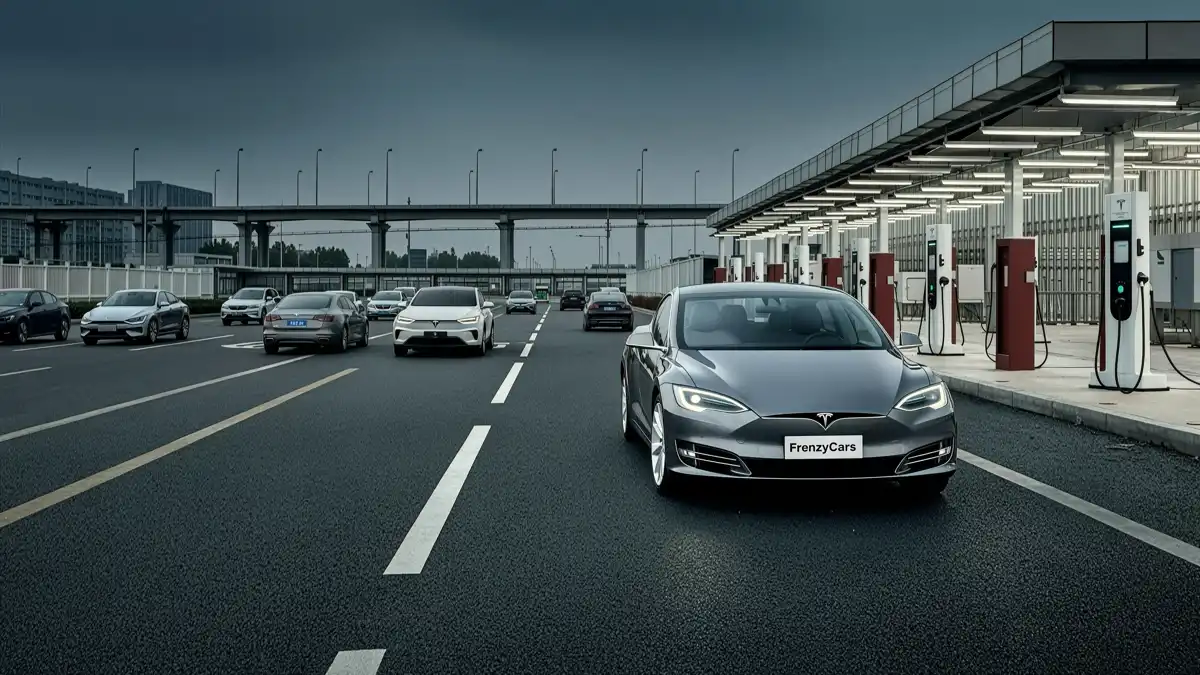
Chinese regulators have ordered Tesla to recall roughly 2.98 million electric vehicles in China because of door handle safety risks, marking the company’s largest recall in the country and part of a cross-industry campaign covering more than 4 million cars. The action, announced Friday by Chinese authorities, sweeps in the Model 3, Model Y, Model X and Model S, both China-built and imported, according to the Associated Press. The recall is the biggest in China this year, Chinese media reported, and it arrives just months after regulators signaled a crackdown on hidden door handles.
The Door Handle Problem That Triggered China’s Biggest EV Recall
The heart of the recall is not a battery issue or an assisted-driving glitch; it is the flush door handle design that has become a signature of many modern EVs, Tesla’s included. Chinese authorities have stepped up scrutiny of door handles after electric vehicle accidents in which hidden electronic handles failed to function and trapped passengers, both in China and elsewhere. When power is cut or a crash disrupts the electronics, a motorized flush handle can leave occupants unable to open the door from the inside. Tesla’s fix combines warning labels with a software update, and the company will begin rolling out the software changes on Sept. 25, according to China’s market regulator. The labels are intended to make the manual release procedure obvious in an emergency.
This isn’t a surprise move. In February, Chinese authorities said that starting next year they would ban hidden car door handles commonly seen on Tesla and other EVs. Friday’s recall effectively serves as an interim safety campaign for vehicles already on the road. More than just Tesla is caught up in the sweep. Other Chinese carmakers involved include Xiaomi, Geely, Leapmotor and XPENG, and the combined action covers over 4 million vehicles. Reports describing the campaign as China’s largest-ever vehicle recall put the number of participating automakers at anywhere from nine to eleven.
For EV owners, the episode illustrates the trade-off inherent in flush handles. They exist partly for aerodynamic efficiency and visual cleanliness, but they convert a purely mechanical door latch into an electronic convenience feature with a manual fail-safe. The recall’s breadth, spanning Tesla and domestic EV makers alike, signals that regulators increasingly view emergency door release as a fundamental safety system, not a styling footnote.
Tesla’s U.S. Market Share Hit a 2023 High Even as China Cracked Down
The recall lands against a backdrop of strong U.S. results for Tesla. The automaker grabbed 59% of all U.S. electric vehicle sales in the fourth quarter of 2025, according to Cox Automotive data analyzed by The Motley Fool. That is a sharp jump from 41% in the previous quarter and Tesla’s strongest quarterly performance in the U.S. EV market since 2023. So while 2026 has been an interesting and mixed period for Tesla, with regulatory pushback in China, its share of the U.S. EV market has not just held; it has climbed.
The juxtaposition matters for car shoppers. In the U.S., Tesla’s dominance gives it enormous influence over EV design trends, and flush door handles remain common across many brands, not just Tesla. The China recall is a reminder that the same component that helps an EV slip through the air can become a liability when safety regulators decide it is too clever for its own good. Tesla will need to comply with China’s new requirements while continuing to sell in a market where domestic rivals are rapidly expanding. And for anyone considering an EV with hidden handles, the recall provides a clear checklist item: know where the manual release is and whether it works with the vehicle powered down.
The fix in China will be a combination of stickers and software rather than a wholesale replacement of hardware, according to reports. Starting Sept. 25, Tesla will push software changes to affected vehicles while owners receive warning labels explaining the emergency release. It’s a relatively low-cost repair, but the regulatory message is anything but minor: hidden door handles are now a safety-critical piece of equipment in China, and automakers that popularized the design have been put on notice. Tesla’s U.S. numbers suggest the brand’s appeal hasn’t faltered, but the recall is a concrete example of how global safety policy can reshape even the most dominant EV maker’s plans.