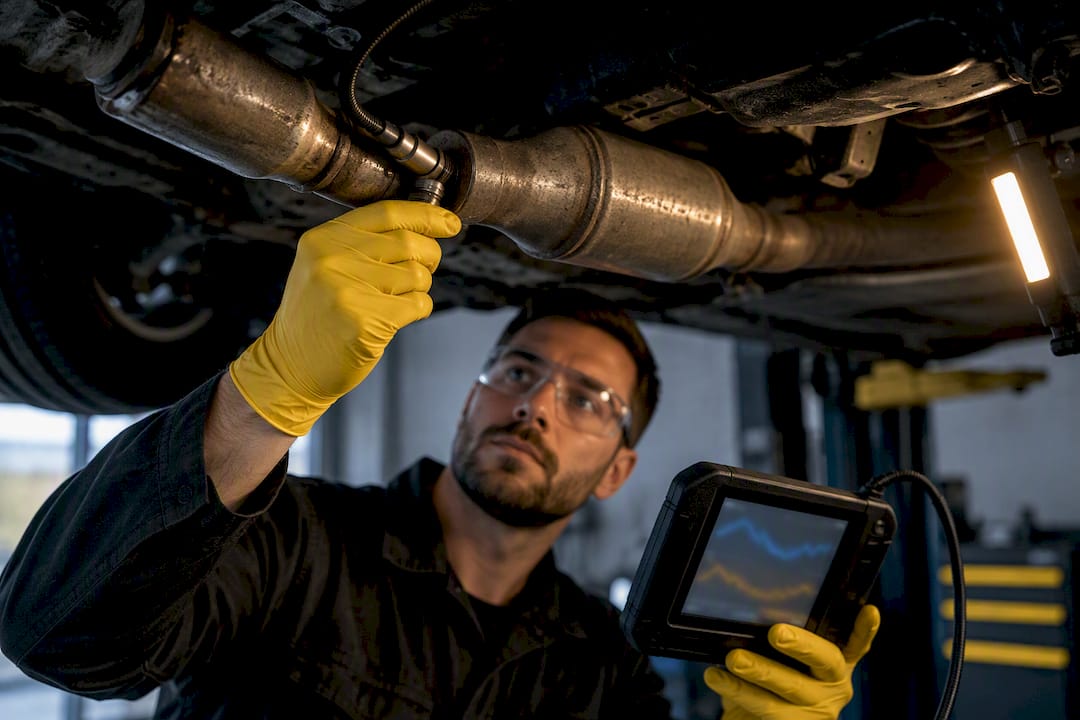
Don’t replace the catalytic converter first. A P0420 code fix starts with confirming the actual cause using live O2 sensor data and a short diagnostic workflow, not a parts swap. Scan for related codes, pull the freeze-frame data, and log upstream versus downstream oxygen readings. Nine times out of ten, a lazy sensor, an exhaust leak, or a misfire is the real culprit hiding behind that catalyst warning.
TL;DR:
- Most P0420 diagnoses are caused by a failing downstream oxygen sensor, exhaust leaks, or engine misfires, not necessarily a worn-out catalyst.
- Diagnosing the problem requires live O2 waveform comparison, fuel trims analysis, and leak testing before considering converter replacement.
- Replacing a sensor or sealing exhaust leaks typically costs under $400, while full converter replacement can exceed $2,500, depending on certification and vehicle specifics.
- Drive cycles and rechecking monitor readiness after repairs are essential to confirm the fix, as a code return indicates residual issues remain.
- Ignoring the warning risks emissions test failure and potential engine damage if underlying causes like misfires or leaks persist.
What P0420 Actually Means and How It Shows Up
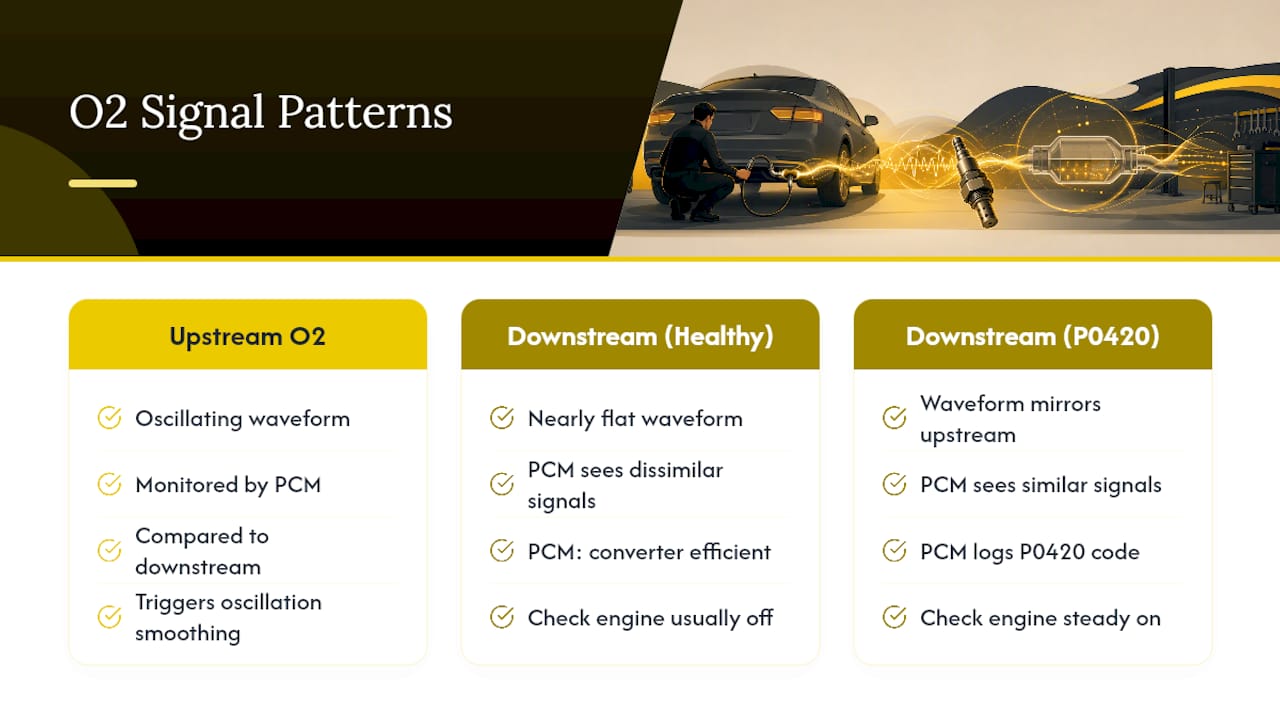
P0420 stands for “Catalyst System Efficiency Below Threshold (Bank 1).” Your engine computer, the PCM, watches the oxygen sensor signal before the catalytic converter and compares it to the signal after it. A healthy converter smooths out the oscillating upstream signal into a nearly flat downstream one. When the two signals start looking too similar, the PCM concludes the converter isn’t scrubbing exhaust gases efficiently anymore, and it logs the code.
Most drivers never notice a drivability change. The check engine light comes on and stays on, steady rather than flashing, and the car often drives exactly the way it did the day before. Some owners report a faint sulfur smell near the exhaust. The real consequence shows up at the emissions testing station, not on the road, since P0420 commonly results from sensor faults, exhaust leaks, misfires, or contamination rather than a converter that simply wore out on its own.
Prioritized Common Causes to Consider First
Converters rarely fail in isolation. Something upstream usually damages them or fools the sensor watching them, and figuring out which comes first saves real money.
- A lazy or failing downstream oxygen sensor (B1S2): this is the single most frequent culprit, and it’s the cheapest to rule out.
- An exhaust leak between the sensors or at the manifold flange: outside air leaking in skews the downstream reading and mimics a dying catalyst.
- Engine misfires or sustained rich/lean fuel trims: these dump unburned fuel into the converter, cooking it from the inside over time.
- Contamination from oil or coolant: a leaking valve seal or a blown head gasket can coat the substrate and choke it.
- Wiring, connector corrosion, or PCM calibration issues: sometimes the hardware is fine and a software update or a chafed wire is the whole story.
The order matters. Fixing a misfire after you’ve already replaced the converter means you’re likely paying for a second converter down the road, since Steer’s diagnostic tree treats engine health as a precondition, not an afterthought.
How Do You Diagnose a P0420 Code Step by Step?
Skipping straight to a converter swap is the single most expensive mistake owners make with this code. Work through this sequence instead, and you’ll know exactly what you’re paying for before you pay for it.
- Pull the stored codes and freeze-frame snapshot. Freeze-frame data tells you the RPM, load, coolant temperature, and fuel trims at the exact moment P0420 triggered, which narrows your search immediately.
- Resolve any blocking codes first. Misfire codes (P0300 series), fuel-trim codes, or upstream O2 sensor codes need to be fixed before you can trust anything the catalyst monitor tells you.
- Warm the engine fully, then capture live upstream and downstream O2 waveforms at idle and again at a steady 2,000 to 2,500 RPM cruise. Idle data alone is not enough; the monitor evaluates behavior under load.
- Compare the two waveforms side by side. This is the core of the live-data waveform comparison that separates a real converter problem from a sensor or exhaust problem.
- Check Mode 06 catalyst monitor values against the thresholds your scan tool reports. Values that clear the threshold with margin point away from the converter; values sitting right at the line, with everything else clean, point toward it.
- Smoke test or propane enrichment around the exhaust joints and sensor bungs to rule out an air leak feeding the downstream sensor false oxygen readings.
- Review long-term fuel trims and misfire counters in the freeze-frame or live data. Trims running consistently above 10 percent, or nonzero misfire counts, mean you have engine work to do before touching the exhaust.
- Run a backpressure test if you suspect physical restriction, such as a collapsed substrate from age or contamination.
- Only after all of that comes back clean upstream does converter replacement become the justified next step.
Pro Tip: Log at least 60 seconds of live data at cruise, not just a snapshot. A single frozen reading can look identical for a healthy converter and a failing one; the trend over time is what actually tells the story.
Manufacturers occasionally complicate this picture. Check for TSBs and PCM calibration updates specific to your vehicle before condemning any hardware, since some catalyst monitor logic has been revised after the fact.
How to Test O2 Sensors and Read the Pass/Fail Signs
A warmed-up upstream oxygen sensor should oscillate steadily between roughly 0.1V and 0.9V, cycling about once or twice per second. That constant swing is the PCM’s proof the engine is running in a tight loop around the ideal air-fuel mixture.
The downstream sensor tells a different story when everything is healthy. At steady cruise, it should sit relatively flat, typically around 0.6 to 0.7 volts, with only small, slow drifts. The moment that downstream trace starts mirroring the upstream oscillation, rising and falling in step with it, you’re looking at a converter that’s no longer buffering the exhaust stream, which is the textbook signature of catalyst inefficiency.
- Capture both traces simultaneously with a graphing OBD-II scanner or a logging app rather than eyeballing two separate numbers.
- A downstream sensor stuck at a constant, unmoving voltage (not the normal flat cruise pattern, but truly frozen) usually means the sensor itself has failed, not the converter.
- If only the downstream trace looks erratic while the upstream signal and Mode 06 values look normal, replace the downstream sensor first. It’s a $150 to $400 part and labor job, far cheaper than guessing wrong on a converter.
Roughly 30 to 40 percent of P0420 cases trace back to a sensor or exhaust leak rather than true converter failure, though the exact share shifts with vehicle age and mileage. That’s a meaningful chunk of readers who could fix this for under $400 instead of $2,000.
Exhaust Leak Detection and Backpressure Testing Methods
Small leaks near the sensor bungs, flex pipe joints, or manifold flange are notorious for skewing downstream oxygen readings. Fresh outside air seeping into the exhaust stream ahead of the downstream sensor dilutes the reading, making a perfectly good converter look inefficient on paper.
- Smoke test: pump non-toxic smoke into the exhaust system with the tailpipe blocked and watch for it escaping at joints, gaskets, or the sensor threads.
- Propane enrichment: introduce a small, controlled stream of propane near suspected leak points while watching the upstream O2 trace for a reaction; a jump confirms a draw point.
- Backpressure test: thread a gauge into an O2 sensor port or the exhaust manifold and read pressure at idle and again at a steady 2,500 RPM. Rising pressure under load rather than staying steady suggests the substrate has partially collapsed and is restricting flow.
- Contamination check: verify oil level and condition, inspect the PCV system, and check coolant pressure before assuming the converter absorbed oil or antifreeze on its own.
When to Replace the Catalytic Converter and What It Costs
Replacement is justified when three things line up together: the downstream waveform mirrors the upstream trace at cruise, you’ve ruled out exhaust leaks with a smoke test, and the upstream sensor and fuel trims all check out healthy. Add elevated backpressure to that list and you’ve got a strong mechanical case for a collapsed substrate rather than a false alarm.
Repair costs vary a lot depending on what’s actually wrong:
These figures come from typical professional repair estimates, and CARB-compliant units cost more because they carry stricter certification for sale in emissions-controlled states.
Federal law backs you up here, too. Catalytic converters carry an emissions warranty of 8 years or 80,000 miles on most vehicles, so check your mileage and purchase date before paying out of pocket. And don’t skip the root-cause work: replacing a converter without fixing the misfire or fuel-trim problem that killed it just means you’ll be back here again in a few thousand miles, with a second bill.
Practical Repair Steps and How to Verify the Fix Worked
Fix things in this order, and don’t skip ahead:
- Replace the failing sensor if the waveform comparison pointed there. This alone resolves a large share of P0420 cases.
- Repair any exhaust leak found during the smoke test, whether that’s a new gasket, a welded seam, or a replaced flex section.
- Resolve misfires or fuel-trim faults using the freeze-frame and misfire-counter data you already pulled.
- Replace the converter only if the earlier diagnostic steps confirmed real substrate failure.
Catalytic converter cleaners occasionally help, but only in a narrow set of cases involving light carbon buildup rather than physical damage or contamination; treat them as a low-cost experiment, not a real fix, and don’t expect them to rescue a converter that’s mechanically collapsed.
Pro Tip: After any repair, clear the codes and drive through a full OBD-II drive cycle, which usually includes a mix of idle time, steady highway speed, and deceleration. Then recheck Mode 06 values and the live O2 waveform before declaring victory. A code that doesn’t come back after one short trip can still return after the monitor fully resets.
Your verification checklist: clear the code, complete the required drive cycles, confirm the catalyst monitor shows “ready,” and pull the live waveform one more time to make sure the downstream trace looks flat again, not mirrored.
Can You Drive With P0420 and Will It Fail Emissions?
Short term, driving with P0420 alone is usually safe, as long as it isn’t paired with misfires, overheating, or a noticeable loss of power. Those combinations point to something more urgent than a slow-degrading catalyst.
Emissions testing is where this code becomes unavoidable. Under federal OBD-II monitoring rules, a stored P0420 causes an automatic failure at an OBD-II-based inspection station, no tailpipe sniffing required. Clearing the code right before your test doesn’t help either. It just triggers a readiness-monitor failure instead, since the catalyst monitor needs several completed drive cycles to report back as “ready.” Plan to diagnose and repair within a few weeks of the light coming on, sooner if you notice any power loss or rough running alongside it.
Choosing and Installing a Replacement Catalytic Converter
Once the evidence genuinely points to the converter, fitment matters as much as price. Buy a converter designed for your exact engine and emissions configuration, matched by year, engine size, and drivetrain, not just “will bolt up.” A universal-fit converter can bolt on and still fail an inspection or throw a new code if the oxygen sensor placement or cell density doesn’t match your PCM’s expectations.
Decide between OEM and aftermarket early. OEM units cost more but guarantee correct fitment and emissions certification for your specific vehicle. Aftermarket converters can save money, but confirm they carry CARB certification if you live in a state that requires it. Installing a non-compliant converter in a CARB state is a common, expensive mistake.
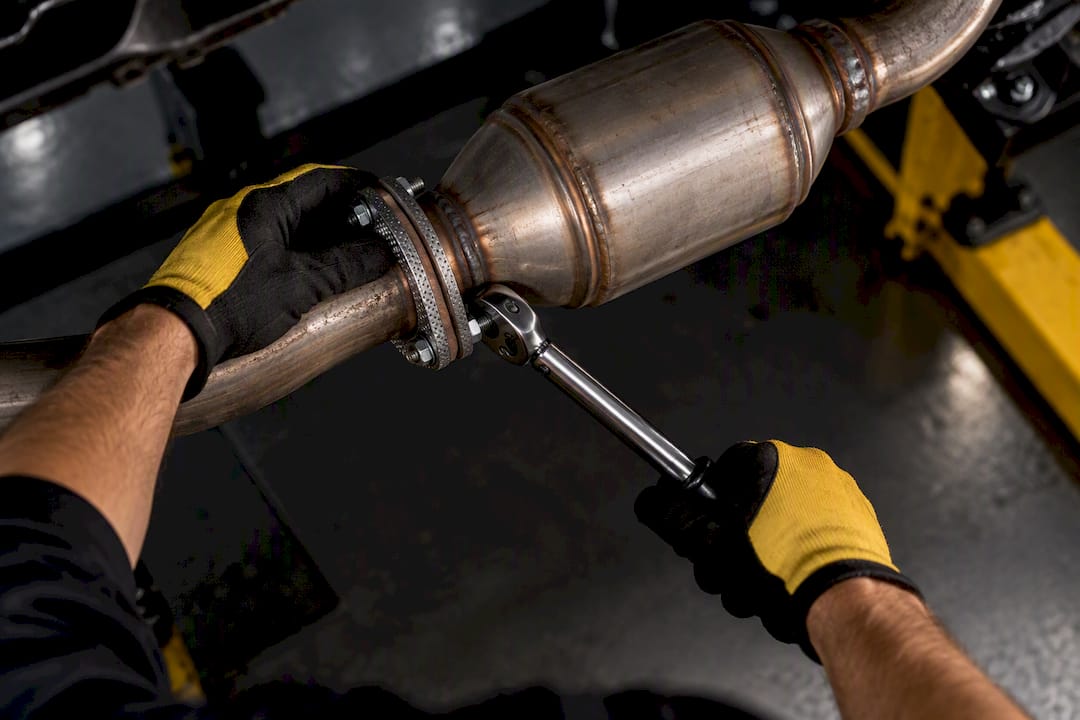
Before installation, inspect and typically replace the gaskets at both flanges. Reusing old, compressed gaskets on a new converter is a leading cause of a fresh exhaust leak right after the repair, the exact problem that put you here in the first place. Torque the flange bolts to spec in a criss-cross pattern rather than one side at a time, which prevents warping the new flange surface.
After bolting everything up, don’t just clear the code and call it done. Run the vehicle through a full drive cycle, then recheck the live O2 waveform and Mode 06 values one more time. This confirms the new converter is actually performing at spec rather than just physically present. If you’re not comfortable with a lift, exhaust welding, or handling an emissions-warranted part, a qualified shop is worth the labor cost here.
Long-Term Maintenance Tips to Prevent P0420 Recurrence
A new converter installed on an engine with underlying problems is just a countdown to the next P0420. Protecting your investment means protecting what feeds it.
Address misfires immediately rather than living with an occasional stumble. Even minor, intermittent misfires dump unburned fuel downstream and shorten a converter’s life dramatically over tens of thousands of miles. Replace spark plugs and ignition coils on schedule, and don’t ignore a rough idle just because the check engine light hasn’t come on yet.
Watch your fuel trims periodically if you have a scan tool capable of live data. Trims that drift wider over time often signal a developing vacuum leak, a failing fuel injector, or a weakening upstream sensor, all of which stress the converter before they trigger their own codes.
Keep an eye on oil consumption and coolant level, too. A slow oil leak past worn valve seals or a small coolant leak into the combustion chamber will contaminate a converter just as surely as a rich fuel mixture will, and neither shows up as an obvious symptom until the damage is done.
Finally, don’t ignore a fresh exhaust rattle or a new smell after any exhaust work, including your own. A gasket that starts seeping months after a repair is easier to catch during a quick visual check than after it’s fooled your downstream sensor again.
FrenzyCars Perspective and DIY Checklist
A diagnose-first workflow is recommended because it can save money: scan, freeze-frame, live O2 graphs, fuel trims, leaks, backpressure. Copy that order onto a sticky note before you touch a wrench. Skipping steps is how a $200 sensor fix turns into an $1,800 converter regret.
Where to Learn More Before You Start Wrenching
Diagnosing P0420 correctly means understanding your specific engine’s known issues, and that’s where model-specific research pays off. Before you commit to a repair path, check Frenzycars’s car specs by make and model for fitment details and known quirks tied to your exact engine and trim. It’s a useful second stop after the diagnostic steps above, since a “universal fix” article can’t tell you whether your particular V6 has a documented sensor-bung leak pattern or a TSB covering catalyst monitor calibration.
If the code showed up alongside a flashing rather than steady check engine light, treat that as a different, more urgent situation. Frenzycars breaks down what a flashing check engine light means and why it can lead to a $2,500 repair if ignored, which is worth reading before you assume P0420 is your only problem.
For odor complaints tied to exhaust or catalyst issues specifically, diagnosing the source before treating the smell prevents you from masking a symptom instead of fixing it. And if your diagnosis points to a repair requiring a lift, exhaust welding, or a CARB-compliant converter, that’s a job for a shop with the right equipment and emissions-warranty paperwork on hand rather than a driveway fix.
Sources
- P0420 Code: The Guide to Diagnosis and Fast Fixes
- P0420 — Catalyst System Efficiency Below Threshold (Bank 1) — iCarsoft Knowledge Hub
- P0420 Catalyst Efficiency Bank 1: Diagnostic Tree & Fix - Steer
- Ecfr