
If you drive solo or with one passenger most days, a subcompact SUV gives you the easiest parking and lowest running costs. Couples and small families usually land best in a compact or midsize two-row. A growing family that regularly hauls kids’ friends, gear, and groceries at the same time needs a midsize three-row or a full-size. If you tow a boat, camper, or trailer more than a few times a year, size up to a midsize with a trim-verified tow rating or go full-size.
A two-row midsize often beats a three-row of the same size for daily life. A third row eats into cargo space you’ll use every week for a seat you might use twice a year.
- Solo/couple, city driving: subcompact or compact
- Small family, occasional road trips: compact or two-row midsize
- Growing family, carpools, sports gear: midsize three-row or full-size
- Frequent towing or large groups: full-size or heavy-duty midsize trim
Quick reality check: Consumer Reports points out that a well-configured five-seater can offer more usable cargo space than a cramped three-row you rarely fill. Bigger isn’t automatically better. It’s about matching the vehicle to what you actually do on a Tuesday, not what you might do once a year.
Key Takeaways
The right SUV size comes from matching weekly passenger counts and cargo habits to a class, not from buying maximum capacity for rare events.
| Point | Details |
|---|---|
| Size for your week | Count typical passengers and cargo loads, not once-a-year maximums, before picking a class. |
| Two-row often beats three-row | A well-configured midsize two-row can offer more usable cargo than a cramped three-row you rarely fill. |
| Check trim-specific towing | Towing capacity varies by thousands of pounds within the same model, so verify per-trim, not by name. |
| Test with real gear | Bring your child seat, stroller, and luggage to the test drive, not just yourself. |
| Confirm specs before shopping | Use tools like Frenzycars’ Car Specs to verify cargo, towing, and dimensions before test-driving. |
How to Choose the Right SUV Size for Your Household
The honest answer to “how do I select the right SUV size” isn’t a single number. It’s a match between your weekly routine and a size class. Most buyers overshoot, paying for third-row seats and towing capacity they use rarely, then complain about fuel costs and parking every single day. The fix is simple: count your actual weekly passengers and cargo, not your best-case scenario.
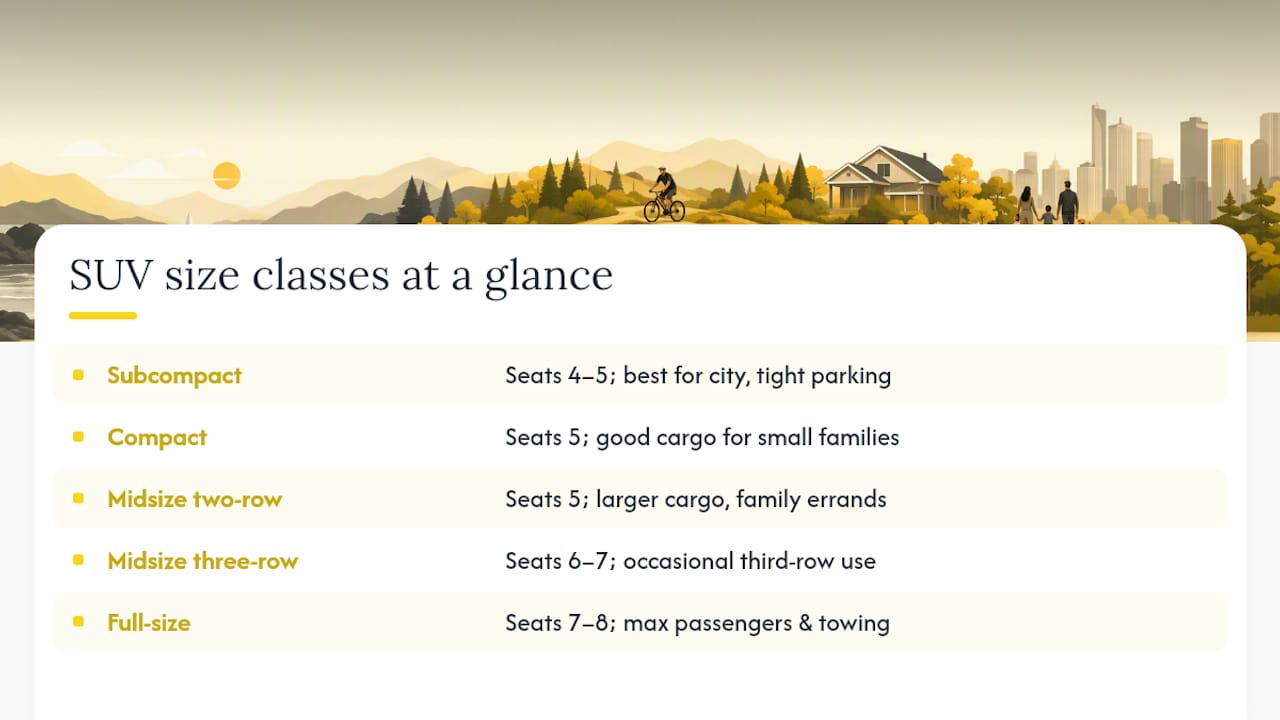
Kelley Blue Book breaks the market into five broad classes, subcompact, compact, midsize two-row, midsize three-row, and full-size, but notes that dimensions and prices overlap heavily between neighboring classes. A loaded compact can be roomier than a base midsize. That overlap is exactly why a size buying guide needs to go beyond class labels and into real usage patterns, which is what the rest of this guide does, section by section.
Subcompact SUVs: Who They Suit and Real Limitations

Subcompacts (think Honda HR-V, Chevy Trailblazer, Kia Seltos class) are built for people who drive more than they haul. You get five seats and a small cargo area behind the rear row, usually just enough for a couple of grocery runs or a weekend bag, not both at once.
The upside is real: tighter turning radius, easier street parking, and some of the best fuel economy in the SUV world. Cartelligent puts subcompact length in the shortest band of the SUV market, which explains why they slide into tight garages and city spots that swallow a midsize whole.
Where they fall short:
- Rear-seat legroom gets tight fast with two adults or two car seats side by side.
- Towing capacity is minimal or nonexistent on most trims.
- Cargo behind the rear seats shrinks quickly once you add a stroller or a case of water.
Check Fueleconomy for exact mpg by trim, but subcompacts commonly land in the strongest fuel-economy tier of the segment, with MSRPs that typically start well below compact and midsize competitors. If your household is one or two adults with occasional passengers, this class often covers everything you need without paying for space you won’t use.
Compact SUVs: The Versatile Everyday Choice
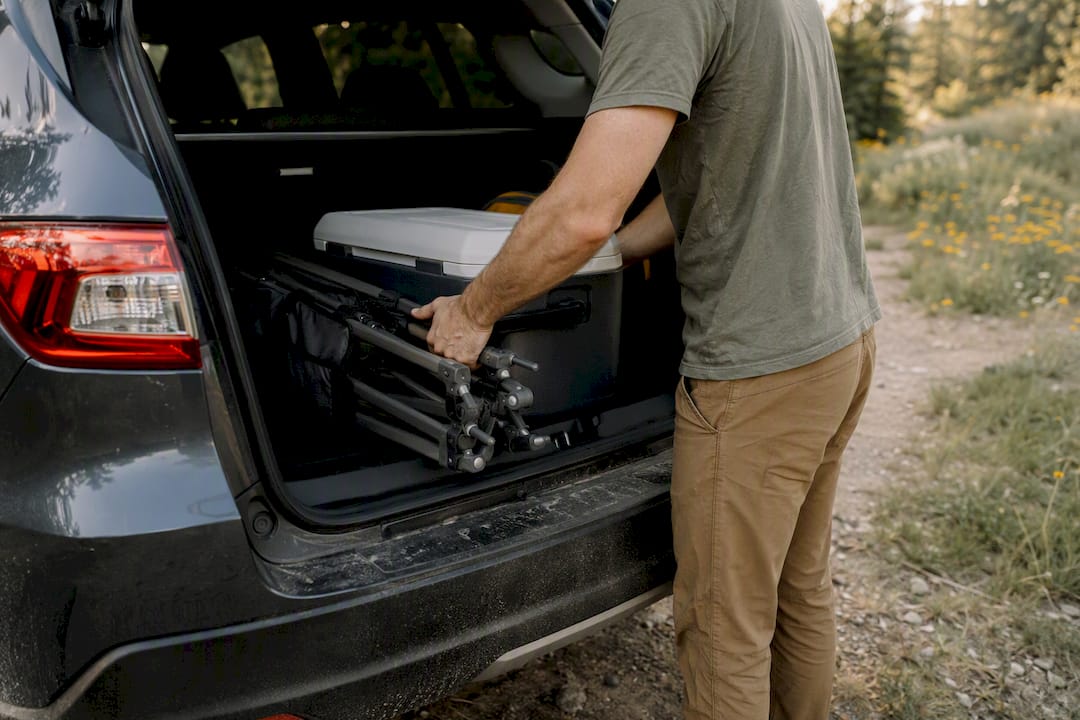
Compact SUVs, the Toyota RAV4, Honda CR-V, Mazda CX-5 class, are the default answer for a huge share of American households, and for good reason. They fit two adults and two or three kids with actual knee room, plus enough cargo for a stroller, a diaper bag, and a Costco run without playing luggage Tetris.
This is where AWD starts to earn its keep. If you live somewhere with real winters or regularly drive gravel or dirt roads to a cabin or trailhead, a compact with AWD adds meaningful traction without the fuel penalty of a bigger V6 midsize. If you’re strictly urban and rarely see snow, front-wheel drive saves money at the pump and at purchase.
- Seats four comfortably, five in a pinch for shorter trips.
- Cargo volume typically handles a week of groceries plus sports gear.
- Fuel economy sits between subcompact and midsize, a genuine middle ground.
- Towing is limited on most trims, fine for a small utility trailer, not a boat.
Compare compact against subcompact on price and against midsize on interior room using KBB’s category breakdown, which shows meaningful overlap at the edges of each class. A well-equipped compact can rival a base midsize on cargo, which is worth checking before you assume you need to size up. For families of three or four without heavy towing needs, this class rarely disappoints.
Midsize Two-Row SUVs: The Practical Family Sweet Spot
This is the class Frenzycars sees underrated most often. Midsize two-row SUVs (Toyota Grand Highlander’s two-row trims, Hyundai Santa Fe, Jeep Grand Cherokee) give you significantly more cargo depth and width than a compact, plus genuinely comfortable rear seats for adults on long drives, without the third-row compromise eating into your trunk space.
Consumer Reports makes a point worth repeating here: a well-designed five-seater often delivers more usable cargo than a three-row SUV of similar footprint, because that extra row and its folding mechanism steal depth from the cargo area behind it. If you rarely need seven seats, a two-row midsize gives you the room without the trade-off.
- Rear legroom typically accommodates adults on multi-hour trips, not just kids.
- Cargo behind the second row usually swallows strollers, sports equipment, and luggage for a family trip.
- Towing capacity varies wildly by trim, some models tow barely 1,000 pounds, others top 6,000, so check the exact configuration.
Pro Tip: Never assume towing capacity from the model name alone. Two trims of the same SUV can differ by thousands of pounds depending on engine and drivetrain, so pull the trim-specific tow rating before you shop for a trailer.
Midsize Three-Row SUVs: When the Third Row Helps and When It Doesn’t
Third-row seating in a midsize SUV (think Kia Telluride, Honda Pilot, Ford Explorer) is genuinely useful for kids, carpools, and the occasional extra passenger. It’s rarely comfortable for adults on anything longer than a short errand. Legroom back there is tight in most midsize three-rows, and headroom often forces a slouch for anyone over 5’8".
Cargo tells the real story. Behind the third row, you often get barely enough space for a few grocery bags. Fold that row down, and you suddenly have a genuinely useful cargo hold for luggage, gear, or a Costco haul.
- Third row works well for kids under 12 and short trips; less so for adults on road trips.
- Cargo behind the third row is usually minimal; folded flat, it competes with two-row midsize volume.
- Choose three-row over a bigger two-row when you regularly, not occasionally, need seats six or seven filled.
If your “need” for a third row is really three or four uses a year, carpooling to a game or hosting visiting relatives, a two-row midsize plus occasional ride-sharing or a second car for those days often works out cheaper and more comfortable the other 350 days of the year.
Full-Size SUVs: Who Genuinely Needs One
Full-size SUVs (Chevy Suburban, Ford Expedition Max, Toyota Sequoia) exist for a specific set of buyers: households that regularly move six or more people including adults, families that tow heavy trailers or boats on a routine basis, or anyone doing long-haul trips fully loaded with people and gear at once.
That capability comes at a cost. Full-size SUVs post the weakest fuel economy in the category, according to typical listings on FuelEconomy.gov, cost more to insure and service, and are noticeably harder to park or maneuver in tight city lots or older parking garages.
- Seats six to eight depending on configuration, with genuine adult-friendly third-row space in most models.
- Cargo behind the third row is usable for real luggage, not just a few bags.
- Towing capacity regularly reaches into the 7,000 to 9,000+ pound range on properly equipped trims.
- Higher purchase price, higher fuel cost, and often a larger footprint than a typical suburban garage bay.
If your towing or passenger needs are occasional rather than weekly, you’re likely paying full-size running costs for a capability you rarely use.
How to Choose: A Step-by-Step Sizing Checklist
Stop comparing spec sheets side by side and start with your actual week. Here’s the order that matters, because getting the priority sequence wrong is how people end up with an SUV that doesn’t fit their life.
- Count your typical weekly passengers, not your maximum. If you’re rarely above four people, don’t shop three-row.
- Measure your cargo reality. Do you carry strollers, sports gear, or work equipment daily? Load your current trunk and see what’s actually in there most days.
- Check your towing frequency honestly. Once a year for a trailer rental doesn’t justify a full-size purchase; consider a rental or a properly-rated midsize trim instead.
- Assess your parking situation. Street parking, a tight garage, or a downtown commute all favor subcompact or compact; a suburban driveway removes that constraint.
- Cross-check your shortlist against a comparison checklist before you visit a dealer, so you’re not making size decisions on the lot under a salesperson’s clock.
This sequence matters because passenger count and cargo needs are daily realities, while towing and maximum capacity are often occasional. Size for the daily pattern first, then confirm the occasional need can still be met, even if imperfectly.
Pro Tip: A dealer and used-market rule worth repeating: size to your week, not your year. Buying a full-size SUV for one annual camping trip means paying full-size fuel and insurance costs the other 51 weeks.
Child Seats, Safety Tech, and Real-World Usability
Cargo liters printed on a spec sheet mean little if the boot has a high lip or a narrow opening that makes loading a stroller a wrestling match. Boot shape and door opening angle matter more day to day than the headline cubic-foot number.
For car seats, check three things before you buy: where the LATCH anchors sit relative to the seat bight, whether the top-tether anchor is easy to reach behind the headrest, and how wide the rear door opens for buckling a squirming toddler without crouching outside the vehicle.
- Confirm LATCH anchor location and clearance with your actual car seat, not a demo unit.
- Test top-tether access, some third-row seats hide it in an awkward spot.
- Check rear door opening angle against your driveway or garage width.
- Prioritize safety tech that helps daily driving: blind-spot monitoring and rear cross-traffic alert matter more in practice than rarely-used features.
Real-world boot usability, opening width and lip height, often matters more than the cubic-liter figure when you’re loading gear one-handed with a toddler on your hip.
Fuel Economy, Running Costs, and Price Ranges by Size
Price and running costs climb steadily as you move up the size ladder, and MSRP overlap between adjacent classes means the class name alone won’t tell you the sticker price. KBB’s buying guide shows meaningful price overlap between a loaded compact and a base midsize, so cross-shop trims, not just categories.
Fuel economy follows a predictable curve: subcompacts post the best mpg, full-size the worst, with compact and midsize filling the middle. Use FuelEconomy.gov to compare exact model-year figures rather than relying on class-wide assumptions, since engine choice and drivetrain shift numbers meaningfully within the same model line.
- AWD typically costs more upfront and trims a few mpg off the fuel economy compared to front-wheel drive.
- Bigger wheels, larger brakes, and heavier curb weight on full-size models mean higher tire and brake replacement costs over time.
- Insurance often scales with vehicle value and size, so a full-size SUV usually costs more to insure than a compact with a similar trim level.
Test-Drive and Fit Checks: What to Bring and What to Measure
A test drive around the block tells you almost nothing about whether an SUV fits your actual life. Bring the gear you use every week.
- Bring your child seat, stroller, and a typical load of luggage or sports gear, plus a rear-seat adult passenger if you regularly carry one.
- Install the car seat yourself in the second and third row if applicable, fold and raise the third row, and load your luggage the way you actually would after a grocery run or a weekend trip.
- Simulate your parking spot, garage, driveway, or a tight street space, to see if the SUV actually fits your daily reality.
- Drive it the way you actually drive: check the turning radius in a parking lot, test blind-spot visibility changing lanes, and sit through at least fifteen minutes behind the wheel to judge seat comfort on a longer haul.
Why Trust This Guide: FrenzyCars Expertise and Sourcing
Frenzycars covers car reviews, maintenance guides, and buying advice with an editorial focus on real-world usability over spec-sheet marketing. This guide was compiled by Ramón, drawing on primary sources rather than dealer talking points.
- Sourced pricing, mpg, and category definitions from Consumer Reports, KBB, and FuelEconomy.gov.
- Cross-referenced dimension bands against reported length data to translate class names into real footprint expectations.
- Focused on practical fit, child-seat access, cargo usability, and weekly-use patterns, not brochure superlatives.
An Editorial Take on Sizing Up Too Fast
Most SUV regret starts with sizing for a rare event, a once-a-year camping trip, a hypothetical third kid, instead of the actual week. Test with your real gear before you buy, not after. The vehicle that fits your Tuesday should win over the one that fits your fantasy road trip.
Confirm the Specs Before You Commit
There are other ways to firm up a shortlist, spec sheets from manufacturer sites, forum threads, dealer brochures, but they’re scattered and often inconsistent on cargo and towing numbers. Frenzycars centralizes that work. The Car Specs by Make and Model tool lets you pull exact cargo volume, towing capacity, and dimensions for a specific trim before you ever set foot on a lot, so you’re not relying on rounded marketing figures. Pair that with Best Cars by Category once you know your size band from this guide, and you can narrow a dozen options down to three worth test-driving in an afternoon. Start with the Car Specs page, confirm the numbers that matter for your household, then build your test-drive list from there.